
Cincinnati Art Museum UX Research
Introduction
This portfolio piece will tell a story of the many aspects of industry-standard
user experience design steps and techniques that I learned about and
worked on with a team of students for the duration of a semester. This will be
primarily focused on the Cincinnati Art Museum and its website, as that is
what our group chose. We developed our skills and learned in class about
the many steps of fully going through the user experience testing process,
and then we were given the opportunity to put them into practice, analyzing
and testing the Cincinnati Art Museum website. I learned many valuable
skills and industry-standard practices across the duration of the semester, and now I will take you step-by-step through the process.
Hueristic Analysis
The process of completing a Heuristic Analysis of our website was an important step in understanding the strengths and weaknesses of the Cincinnati Art Museum’s website. We had never completed a Heuristic analysis before, so this was very insightful and allowed us to understand how to properly analyze content using a Heuristic evaluation protocol. We began the process by doing a deep dive into their website for the first time, and once I found good and bad examples of these different categories, we went forward and made recommendations for each category based on any issues that we found. We found that many categories were not much of an issue for the Cincinnati Art Museum, which gave our group a good idea of what issues we should focus on and which ones we should leave behind

Competitive Research
Competitive Research Completing competitive research allowed our group to look at what some of the art museum’s largest competitors are doing really well, and not very well, and see how we compare. Each member of our group picked a possible competitor, and then analyzed them based on different criteria we
found to be most applicable to the Cincinnati Art Museum.
We found that completing competitive research allowed us to see how some other art museums, such as The Met, have incredibly strong tone and design that match the overall experience a visitor
could expect when they visit the museum itself. We also discovered that the ticketing process that competitors utilize is much smoother for users than the Cincinnati Art Museum’s current ticketing system, providing a good point of reference. In general, there was no perfect website, so moving forward, it was important to keep in mind what was lacking from all of them and focus on making their website the best.

Usability Testing
It is hard to move forward in learning more about the issues of a website without completing usability testing to understand what the site is doing well, versus what it really needs work on. We began by writing out our User Goals, which served as a guide for all of our scenarios within our testing. We did a lot of ideation to come up with our scenarios that weren’t too specific, but also highlighted the specific issues that we wanted our users to possibly comment on during testing. We also had to practice the think-aloud protocol for our users before we put them through our scenarios, in order to get the most detailed information out of them and allow us to truly understand what was going through their heads.
This was a bit of a challenge, as it feels awkward the first time, and it can be hard for participants to know if they are doing it right. Our group completed and recorded 5 different usability testing sessions, all following the same protocol and scenarios, ensuring consistency across the board. After this, we came together, analyzed our data, and measured the ease of each task, as well as any comments made by users, to ensure we were all on the same page


After delving into the insights gathered from our usability testing, we began to see a story being told. Some glaring issues were consistent across the board, which led us to develop 5 different findings, as well as some suggestions as to what the Cincinnati Art Museum could do to improve the issues discovered in our findings.
We presented these findings to our class, providing insight into our interviews, and showing live on their website how these issues look for the average user. In moving forward, we learned how it would be to go through the usability testing process for a client, and then present our findings to the client, supporting those findings with evidence, quotes, and then providing next steps or possible solutions that the client can take to improve their website. This was challenging, though, because we had to all be on the same page as a group, and in the future, I would have prepared better so that our group was better at cohesively answering questions.

In-Depth Interviews
In-depth interviews were our next step in the class, and it was honestly difficult shifting our group’s mindset from every question being very website-oriented to being more general about the museum-going experience. Once we figured out what the questions were really supposed to look like, we brainstormed some possible interview questions individually, and then came together and each contributed a few questions to the final interview guide.
Some of my group members did a good job of coming up with questions that were about museum websites in general, which were very helpful, and very different from what I thought of when creating my questions, which I think really amplifies the importance of working in groups, versus what you can come up with on your own. I found coming up with questions for the in-depth interviews was much easier than the usability testing scenarios, because they were much broader and focused on the general experience.
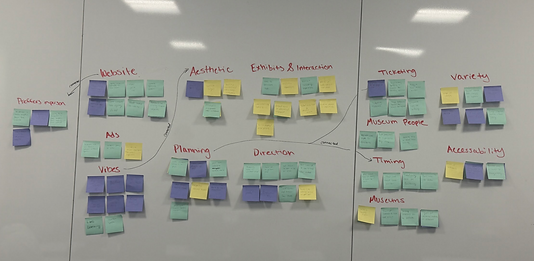
This step of the overall in-depth interview process was by far my favorite, because it truly challenged our group to find similarities and groupings amongst the codes that we wrote from our interviews. We all wrote out our codes and stuck them on the board, and read through them and discussed if there were any identical or similar to be able to form groups. This process was very chaotic, and in the future, I would maybe take a different, more organized approach, as we started with them all scattered all over the board, and I think starting with them more organized would have made the sorting process a lot easier.
We eventually broke our similar groupings up into categories, giving them names, but we were then challenged to break up some of our larger categories into more specific ones, leaving us with what you see to the left. We also decided it would be interesting to make arrows pointing out how some of them are connected or similar to others, expanding upon just the categories, by connecting them and relating them to each other.


Affinity Mapping
This step of the overall in-depth interview process was by far my favorite, because it truly challenged our group to find similarities and groupings amongst the codes that we wrote from our interviews. We all wrote out our codes and stuck them on the board, and read through them and discussed if there were any identical or
similar to be able to form groups. This process was very chaotic, and in the future, I would maybe take a different, more organized approach, as we started with them all scattered all over the board, and I think starting with them more organized would have made the sorting process a lot easier.
We eventually broke our similar groupings up into categories, giving them names, but we were then challenged to break up some of our larger categories into more specific ones, leaving us with what you see to the left. We also decided it would be interesting to make arrows pointing out how some of them are connected or similar to
others, expanding upon just the categories, by connecting them and relating them to each other.
Empathy Mapping
Empathy mapping is a huge step in understanding the small details that go into a persona, so I am glad we did this before finalizing
our persona. I think this step is very important, though, because it really forces you to get into the head of your persona, and understand their motivations, why they think or feel a certain way
about things, and overall how they view the world, and how that has. an influence on how they interact with a museum.
I found myself focused very heavily on the kids in this empathy map, which I think is very accurate to the inside of a mom’s head, which I am ultimately very happy with, however, if I were to do my empathy map again, I would also include a few more aspects about what Sarah was thinking and feeling in regards to herself, and her needs as well, because ultimately a lot of what she is doing for her kids, she is hoping will benefit her as well, by possibly having her hands less full, or having less planning to do on her own if she just goes and visits a museum.

Persona Development
Persona development was also an aspect of the interview process that I really enjoyed, as it allows creative thinking, but also plays into different stereotypes of what you might imagine to see when walking through a museum. We began by brainstorming some initial traits of our persona, Sarah Bobinsky, so that we had a jumping off-
point, as well as ensuring we were all on the same page as to who Sarah is. After we had her general characteristics and needs fleshed out, we created an in-depth person that we initially created, and
then we shared it with another group in our class for feedback.
In receiving feedback, we shortened her personal background, shortened the quote, and ended up with what is on the left. I think in the future I would work more closely in our group and ensure that we are not getting too specific and off track from the point of the persona. It can be very easy to get too imaginative and have too much fun with a persona, to the point where it takes the reader out
of reality, and begins to feel like a fake person, which is the opposite goal of a persona.

Journey Mapping
The last step our group took to understand personas, based on our in-depth interviews, was Journey Mapping, which is something I had never done before, so I personally found this step to be slightly challenging. We took a new persona that we might see at an art museum, named Kelsey Cobb, who is a college student, and went through her emotional and overall journey in her experience at the museum. We made sure to highlight any pain points and things that we have found users struggle with based on our in-depth interviews within the emotions section.
You can see in ticketing and exploring, Kelsey leans more towards frustration, as those are the things that tend to be a bit more overwhelming and intimidating within a museum-going experience. Overall, I think this really forced our group to list some aspects about a museum experience that could be amazing, and challenging for a specific persona, and individual, which I think is a hard skill to learn, and personally, I think this is an aspect that I want to get more practice at to ensure it is a skill that I have moving forward.

Reflection
This experience has been incredibly educational, and I know now moving forward what aspects of User Experience Design I am very good at, and the areas that I need to develop my skills in, in order to be the best UX designer I can be. I found that working in groups for most aspects of this course allowed for a very real idea of what UX research may look like, as well as how to properly collaborate and use each individual’s expertise in the field in order to reach the best outcome possible. If I were to do these projects again with my group, I would likely ensure that we are all communicating a cohesive mindset surrounding findings, personas, etc. I think this would have allowed our group to collaborate even better, and I believe it would be more of a realistic representation of what working in the field in a team setting is truly like, especially when having to present findings to a client.